Key Takeaway
The only organic Navaratna. Complete guide: Moon connection, Basra vs. South Sea vs. freshwater, how to identify real Pearl, and wearing protocol.
Free · Online · 2 Minutes
Get a personalized Vedic gemstone recommendation based on your birth chart — not just your sun sign.
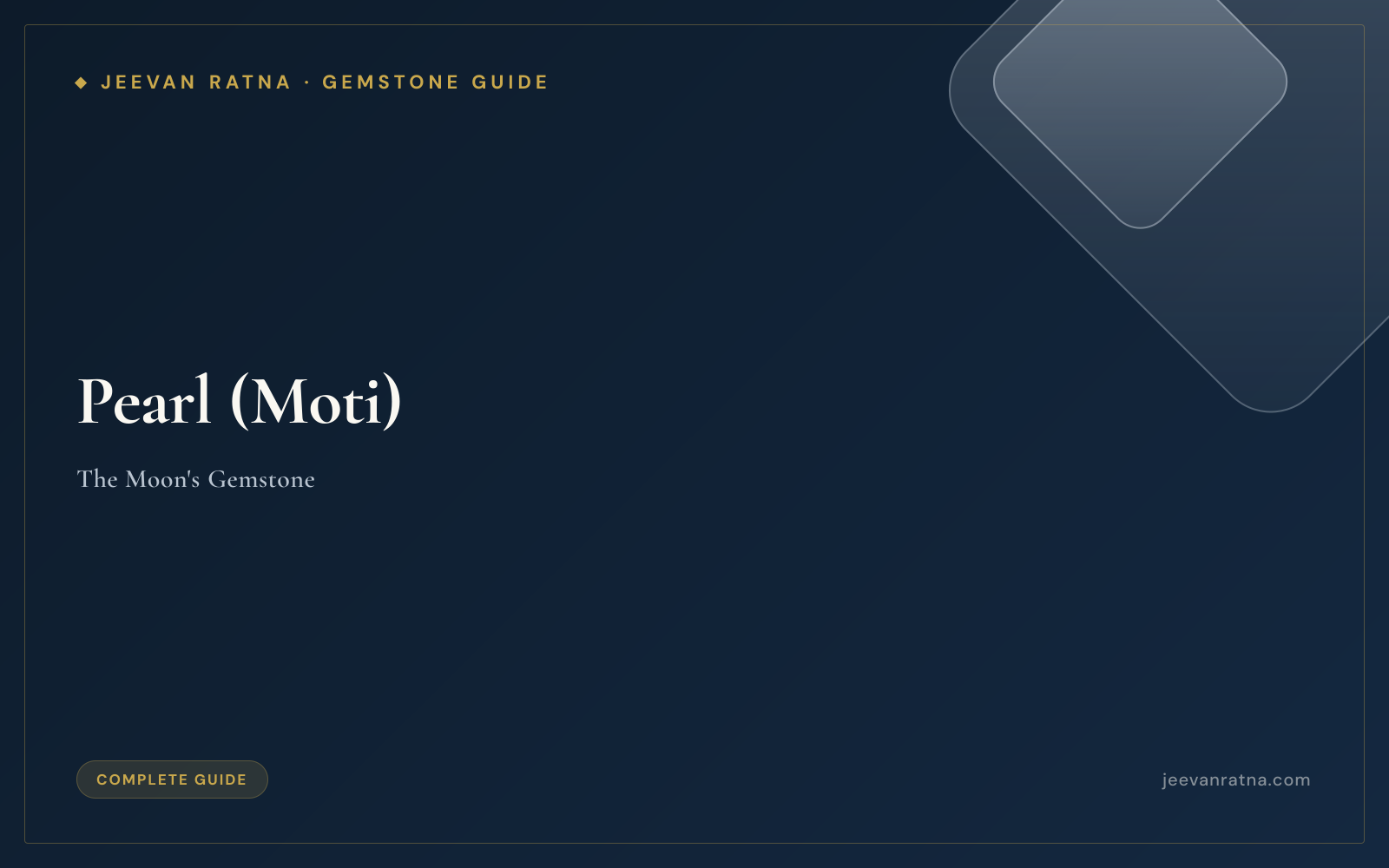
Pearl is the only gemstone created by a living creature. Every other stone in the Navaratna — Ruby, Sapphire, Emerald — is a mineral formed by geological processes over millions of years. Pearl forms inside an oyster or mussel in months to years, as the creature secretes layers of nacre (calcium carbonate + conchiolin protein) around an irritant.
This biological origin makes Pearl unique in Vedic astrology: it is simultaneously a jewel and an organic material. The Garuda Purana and Ratnapariksha both describe the Pearl (Mukta or Moti) as the gemstone of Chandra (the Moon) — carrying lunar energy of mind, emotions, mother, and intuition. A weak Moon in the birth chart manifests as mental restlessness, emotional instability, anxiety, poor sleep, and strained maternal relationships. Pearl is prescribed to strengthen the Moon and address these issues.
Key Takeaways
- Pearl (Moti) is the Moon's gemstone in Vedic astrology — it strengthens the Moon and addresses emotional instability, anxiety, and poor sleep
- Natural pearls (uncultured, formed without human intervention) are extremely rare; South Sea cultured pearls are the practical astrological standard
- Basra pearls from the Persian Gulf are most prized in Vedic tradition; South Sea cultured pearls are widely accepted as effective
- Pearl shows astrological effects faster than most other stones — within 2–4 weeks — because the Moon moves rapidly through the zodiac
- Cancer Lagna individuals benefit most from Pearl; it is also prescribed for all Lagnas where the Moon is weak or afflicted
The Moon's Gemstone: Why Pearl?
The Moon governs water, and Pearl is formed in water. Both are white, luminous, and waxing and waning (the Pearl's luster changes as it ages, just as the Moon cycles). In Vedic cosmology, the connection is not metaphorical — it is a vibrational correspondence. The crystal structure of nacre is believed to resonate with the Moon's frequency and amplify its influence in the wearer's chart.
The Moon moves faster than any other graha — completing a full zodiac cycle in 27–28 days. This rapid movement means the Moon's gemstone (Pearl) shows effects faster than most other astrological stones. Many wearers report noticeable changes in emotional regulation and sleep quality within 2–4 weeks.
Types of Pearl: Natural vs. Cultured vs. Freshwater
| Type | Formation | Astrological value | Price (India) |
|---|---|---|---|
| Natural / Basra Pearl | Spontaneous, no human nucleus. Persian Gulf (Basra). Extremely rare. | Highest | ₹50,000–5,00,000+/carat |
| South Sea Cultured Pearl | Cultured in Pinctada maxima oyster. Australia, Indonesia, Philippines. Large, thick nacre. | High | ₹3,000–25,000/carat |
| Akoya Cultured Pearl | Cultured in Japanese/Chinese Akoya oyster. 5–10mm. Classic white with pink overtone. | Moderate | ₹500–5,000 per piece |
| Tahitian Pearl | Black lip oyster. French Polynesia. Dark body color (black, grey, peacock green). | Moderate — less preferred in Vedic tradition | ₹3,000–20,000/carat |
| Freshwater Cultured Pearl | Mussels in freshwater. China primarily. Wide variety of shapes and colors. | Low to moderate | ₹50–500 per piece |
| Imitation / Plastic Pearl | Glass, plastic, or shell coated with pearlescent paint. | None | ₹5–50 per piece |
Benefits of Wearing Pearl (Moti)
The Moon in Vedic astrology governs specific areas of life. A strong Moon brings stability in these areas; a weak Moon causes challenges. Pearl strengthens the Moon:
1. Mental Clarity and Emotional Stability
The Moon governs the Manas (the mind and emotional body). A weakly placed Moon manifests as overthinking, anxiety, mood swings, and emotional reactivity. Pearl calms mental turbulence. Those who have Moon in the 6th, 8th, or 12th house, or a combust Moon (within 12° of the Sun), often report the strongest emotional effects from wearing Pearl.
2. Better Sleep
The Moon rules the subconscious and sleep cycles. A weak Moon is one of the first things a Vedic astrologer checks in cases of chronic insomnia, vivid nightmares, or disrupted sleep. Pearl is among the most consistently reported gemstones for improving sleep quality.
3. Mother's Health and Relationship
The Moon also governs the mother (Matru Karaka). A debilitated or afflicted Moon can indicate strained maternal bonds or the mother's ill-health. Pearl worn with sincerity is traditionally prescribed to improve this karaka.
4. Creativity and Intuition
The Moon governs imagination, artistic sensitivity, and intuitive intelligence. Dancers, poets, musicians, and visual artists with weakly placed Moons often find Pearl amplifies creative flow and emotional expression in their work.
5. Water-Related Professions
The Moon rules water, and by extension: seafaring, hospitality, food and beverages, nursing, and caregiving. Those in these professions with a weak Moon often benefit from Pearl for professional momentum.
Who Should Wear Pearl? Lagna-by-Lagna Guide
| Lagna | Moon rules | Recommendation |
|---|---|---|
| Cancer (Karka) | 1st house (Lagna Lord) | ✅ Highly recommended — Moon is the chart ruler |
| Scorpio (Vrishchika) | 9th house (Bhagya) | ✅ Excellent — Moon governs fortune and dharma |
| Aries (Mesha) | 4th house (home, mother) | ✅ Good — Moon strengthens home and mental peace |
| Taurus (Vrishabha) | 3rd house (communication) | ⚠️ Neutral — review chart before wearing |
| Leo (Simha) | 12th house (moksha, expenses) | ⚠️ With caution — confirm with astrologer |
| Sagittarius (Dhanu) | 8th house (longevity, obstacles) | ⚠️ Consult astrologer first |
| Libra (Tula) | 10th house (career) | ✅ Good for career and public reputation |
| Capricorn (Makara) | 7th house (partnerships) | ✅ Good for relationships and business partnerships |
| Pisces (Meena) | 5th house (creativity, children) | ✅ Excellent for creativity and children |
| Gemini (Mithuna) | 2nd house (wealth, speech) | ⚠️ Moderate — review Moon sign before wearing |
| Virgo (Kanya) | 11th house (gains) | ⚠️ Moderate — useful for gains, but review full chart |
| Aquarius (Kumbha) | 6th house (enemies, health) | 🚫 Generally avoid — Moon governs a Dusthana |
How to Wear Pearl (Moti)
| Parameter | Specification |
|---|---|
| Metal | Silver (preferred) — also acceptable in white gold or platinum |
| Finger | Little finger (Kanishtika) of the right hand |
| Day to first wear | Monday morning (Shukla Paksha — waxing phase preferred) |
| Time | Within 1 hour of sunrise |
| Minimum weight | 2–3 carats for Akoya; 4–5 carats for South Sea; 6+ carats for maximum effect |
| Mantra (before wearing) | Om Shraam Shreem Shraum Sah Chandramase Namah (108 times) |
| Cleansing | Soak in clean raw milk for 20 minutes, then rinse in Gangajal. Pat dry before wearing. |
| Setting | Open-back setting (stone touches skin) is preferred for maximum energy transmission |
How to Identify a Real Pearl
The Tooth Test
Gently rub the pearl across your front tooth (the enamel surface). Natural and cultured pearls have a slightly gritty, sandpaper-like feel — you can feel the microscopic ridge structure of the nacre platelets. Plastic, glass, or coated imitation pearls feel completely smooth. This test takes 2 seconds and is nearly infallible for identifying fakes.
Luster and Overtone
Natural and high-quality cultured pearls have a deep, rich luster with a visible overtone of pink, silver, or green beneath the body color. This depth is called “orient.” Imitation pearls have a flat, uniform, shiny coating with no depth or overtone.
Temperature
Natural pearls feel cool when first held, warming only after a few seconds against skin. Plastic warms immediately. Glass stays cooler longer but has no orient.
Weight
Real pearls feel heavier than plastic for their size. A lightweight “pearl” that is also too perfectly round is almost certainly plastic or low-quality coated glass.
Care and Maintenance
Pearl is the softest stone in the Navaratna (Mohs 2.5–4.5) and requires the most careful handling:
- Never use ultrasonic or steam cleaning — nacre dissolves
- Avoid acids — perfumes, hairspray, sweat, citrus — all dissolve nacre over time
- Put on Pearl jewellery last (after makeup, perfume, hairspray) and take it off first
- Wipe with a damp soft cloth after every wear to remove skin oils and perspiration
- Store in a cloth pouch, not a hard box or plastic bag — pearls need to breathe
- Restring knotted pearl necklaces every 2–3 years if worn regularly — silk thread weakens
Pearl Across Cultures
The symbolism of Pearl is remarkably consistent across civilizations that had no contact with each other:
India (Vedic): Mukta (the liberated one) — Pearl represents the soul emerging pure from material existence, just as it emerges perfect from the oyster's interior world. It is one of the Ashta Maha Ratnas and has been found in the personal ornaments of the Maurya, Gupta, and Mughal courts.
Ancient Rome: Cleopatra famously dissolved a pearl in wine vinegar at a banquet with Mark Antony — demonstrating her legendary wealth by consuming the most expensive single item at the table.
Islam: The Quran describes paradise as palaces constructed of pearl and other precious stones. The word for pearl in Arabic — “Lulu” — remains one of the most common female names in the Arab world.
China: Dragon pearls — legendary jewels clutched by dragons in Chinese mythology — represent spiritual wisdom and celestial power. Chinese emperors decorated their court regalia with freshwater pearls.
Japan: Mikimoto Kōkichi, who invented cultured pearl farming in 1893, is credited with democratizing a luxury that was previously available only to the richest royalty on earth.
Frequently Asked Questions
What is the difference between natural and cultured pearls for astrology?
Natural pearls form entirely without human intervention. Cultured pearls are induced by inserting a nucleus bead. Both are natural nacre mineral, but Vedic practitioners traditionally prefer natural pearls (especially Basra) for astrological purposes. South Sea cultured pearls are widely accepted as a practical substitute.
Which Lagna should wear Pearl (Moti)?
Cancer Lagna benefits most — the Moon rules the 1st house. Scorpio Lagna (Moon rules 9th — Bhagya), Aries Lagna (Moon rules 4th — home and mother), and Pisces Lagna (Moon rules 5th — creativity) are also excellent. Aquarius Lagna should generally avoid Pearl — Moon governs the 6th house.
How do I identify a real pearl?
The tooth test: gently rub the pearl across your front tooth. Natural and cultured pearls feel slightly gritty (sandpaper texture). Plastic or glass pearls feel completely smooth. Real pearls also have a visible luster depth (orient) with pink or silver overtones — not flat uniform shine.
What is the price of natural pearl in India?
Natural Basra pearls are extremely rare: ₹50,000–5,00,000+ per carat. South Sea cultured pearls: ₹3,000–25,000 per carat. Akoya cultured pearls: ₹500–5,000 per piece. Freshwater cultured pearls: ₹50–500 per piece. For astrological use, South Sea cultured pearls are the most commonly recommended accessible option.
Frequently Asked Questions
What is the difference between natural and cultured pearls for astrology?
Natural pearls form entirely without human intervention — a parasite or grain of sand enters an oyster and the nacre builds up spontaneously. Cultured pearls are induced by humans inserting a nucleus bead. Both are natural mineral (nacre), but Vedic astrology practitioners traditionally insist on natural pearls (especially Basra pearls from the Persian Gulf) for astrological purposes. Cultured pearls are significantly cheaper and are acceptable as a practical substitute.
Which Lagna should wear Pearl (Moti)?
Pearl strengthens the Moon. Cancer Lagna benefits most — the Moon rules the 1st house. Scorpio Lagna (Moon rules 9th — Bhagya house), Aries Lagna (Moon rules 4th — home and mother), and Sagittarius Lagna (Moon rules 8th — some caution needed) are also common recommendations. Gemini and Virgo Lagnas should avoid Pearl — the Moon rules challenging houses for them.
How do I identify a real pearl?
The tooth test: gently rub the pearl across your front tooth. Natural and cultured pearls feel slightly gritty (sand-paper texture) due to the nacre structure. Plastic or glass pearls feel smooth. Look for a slight overtone of pink or blue in the body color — imitation pearls have a flat, uniform color with no depth. Real pearls also have a slight coolness when first touched.
What is the price of natural pearl in India?
Natural Basra pearls (from the Persian Gulf) are extremely rare and command ₹50,000–5,00,000+ per carat. South Sea cultured pearls range from ₹3,000–25,000 per carat. Akoya cultured pearls (Japanese) are ₹500–5,000 per piece. Freshwater cultured pearls are the most affordable at ₹50–500 per piece. For astrological use, South Sea cultured pearls are the most commonly recommended accessible option.
Can men wear Pearl (Moti) gemstone?
Yes. Gender is not a factor in Vedic gemstone recommendation — what matters is the planet's strength and the Lagna's rulership. Pearl (Moon) is commonly prescribed for both men and women with a weak Moon or for Cancer Lagna individuals (male or female). Men typically wear Pearl set in silver as a ring on the little finger or index finger, or as a pendant.
How long does Pearl take to show results in astrology?
Pearl typically starts showing effects within 10–30 days. The Moon moves quickly through the zodiac (one sign per ~2.5 days), so its gemstone tends to respond faster than those of slower planets like Saturn or Jupiter. Common early effects include improved sleep quality, emotional steadiness, and better interpersonal communication. Full astrological benefit is assessed over 3–6 months.
Is a South Sea pearl more powerful astrologically than a Basra pearl?
Both are natural pearls, but Vedic tradition historically prizes Basra pearls (from the Persian Gulf) most highly, followed by Ceylon (Sri Lanka) pearls. South Sea pearls are larger and have strong nacre but are cultured, not natural. From a purely astrological standpoint, traditional texts favour Basra natural pearls. From a practical standpoint, South Sea cultured pearls are widely accepted as an accessible substitute. Quality of nacre and lustre matter more than origin for most practitioners.
Free · Birth Chart Analysis · Online
Ready to Find Your Ideal Gemstone?
Gemmie uses your Lagna, Dasha period, and functional benefic analysis to identify the right gemstone — the same method professional Vedic astrologers use. Free, online, in 2 minutes.
Trusted by 1,200+ customers · GIA & GTL certified · Free shipping across India
Jeevan Ratna
Certified Gemstone Specialists · Jaipur Since 1962
Every gemstone sold by Jeevan Ratna is third-party certified by government-approved labs. Astrological recommendations follow the Brihat Parashara Hora Shastra (BPHS) — the classical Vedic framework — and are delivered via birth chart analysis, not sun signs.